Publication list
Citation Report
 Google Scholar: 4MNHWX8AAAAJ
 ORCID: 0000-0002-3886-3974
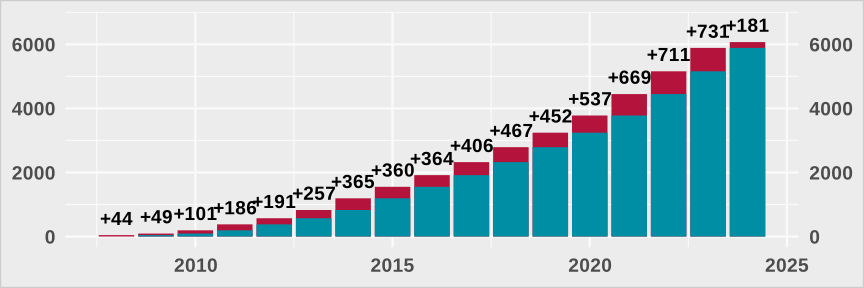
| As of April 02, 2026 |
All |
Since 2021 |
| Citations |
7932 |
4002 |
| h-index |
37 |
30 |
| i10-index |
50 |
43 |
Preprints under Review (Last updated Apr 02, 2026)
- T. Bochynek, F. Schiffers, A. Aichert, O. Cossairt, S. Garnier, and M. Rubenstein. “Anatomy of a superorganism - structure and growth dynamics of army ant bivouacs”. In: arXiv [q-bio.QM] (Oct. 18, 2021). DOI: 10.48550/arXiv.2110.09017. arXiv: 2110.09017 [q-bio.QM].
Refereed Journal Articles (Last updated Apr 02, 2026)
- L. R. O’Bryan, T. Oxendahl, S. Garnier, S. Segarra, M. Wettergreen, A. Sabharwal, and M. E. Beier. “A novel approach to studying the role influence plays in team collective intelligence”. In: Collective intelligence 4.2 (Apr. 2025), p. 26339137251343584. DOI: 10.1177/26339137251343584.
- M. Papadopoulou, S. Garnier, and A. J. King. “swaRmverse: An R package for the comparative analysis of collective motion”. In: Methods in ecology and evolution 16.1 (Jan. 2025), pp. 29-39. DOI: 10.1111/2041-210x.14460.
- M. Pluhacek, S. Garnier, and A. Reina. “Decentralised construction of a global coordinate system in a large swarm of minimalistic robots”. In: Swarm intelligence (Jul. 18, 2025), pp. 1-28. DOI: 10.1007/s11721-025-00251-4.
- D. Carlesso, M. Stewardson, D. J. McLean, G. P. F. Mazué, S. Garnier, O. Feinerman, and C. R. Reid. “Leaderless consensus decision-making determines cooperative transport direction in weaver ants”. In: Proceedings. Biological sciences 291.2028 (Aug. 2024), p. 20232367. DOI: 10.1098/rspb.2023.2367.
- M. Porfiri, N. Abaid, and S. Garnier. “Socially driven negative feedback regulates activity and energy use in ant colonies”. In: PLoS computational biology 20.11 (Nov. 25, 2024), p. e1012623. DOI: 10.1371/journal.pcbi.1012623.
- M. Porfiri, P. De Lellis, E. Aung, S. Meneses, N. Abaid, J. S. Waters, and S. Garnier. “Reverse social contagion as a mechanism for regulating mass behaviors in highly integrated social systems”. In: PNAS nexus (Jun. 26, 2024), p. gae246. DOI: 10.1093/pnasnexus/pgae246.
- D. Rocchini, L. Chieffallo, E. Thouverai, R. D’Introno, F. Dagostin, E. Donini, G. Foody, S. Garnier, G. G. Mazzochini, V. Moudry, B. Rudis, P. Simova, M. Torresani, and J. Nowosad. “Under the mantra: ‘Make use of colorblind friendly graphs’”. In: Environmetrics (Aug. 20, 2024), p. e2877. DOI: 10.1002/env.2877.
- M. Wiśniewska, C. E. O’Connell-Rodwell, W. Kilian, S. Garnier, and G. J. Russell. “Interplay of physical and social drivers of movement in male African savanna elephants”. In: Behavioral ecology: official journal of the International Society for Behavioral Ecology (Nov. 19, 2024), p. arae091. DOI: 10.1093/beheco/arae091.
- N. A. M. Araújo, L. M. C. Janssen, T. Barois, G. Boffetta, I. Cohen, A. Corbetta, O. Dauchot, M. Dijkstra, W. M. Durham, A. Dussutour, S. Garnier, H. Gelderblom, R. Golestanian, L. Isa, G. H. Koenderink, H. Löwen, R. Metzler, M. Polin, C. P. Royall, A. Šarić, A. Sengupta, C. Sykes, V. Trianni, I. Tuval, N. Vogel, J. M. Yeomans, I. Zuriguel, A. Marin, and G. Volpe. “Steering self-organisation through confinement”. In: Soft matter 19.9 (Mar. 01, 2023), pp. 1695-1704. DOI: 10.1039/d2sm01562e.
- D. Carlesso, J. M. McNab, C. J. Lustri, S. Garnier, and C. R. Reid. “A simple mechanism for collective decision-making in the absence of payoff information”. In: Proceedings of the National Academy of Sciences of the United States of America 120.29 (Jul. 18, 2023), p. e2216217120. DOI: 10.1073/pnas.2216217120. eprint: https://www.pnas.org/doi/pdf/10.1073/pnas.2216217120.
- G. Gumuskaya, P. Srivastava, B. G. Cooper, H. Lesser, B. Semegran, S. Garnier, and M. Levin. “Motile Living Biobots Self-Construct from Adult Human Somatic Progenitor Seed Cells”. In: Advancement of science 11.4 (Feb. 22, 2023), p. e2303575. DOI: 10.1002/advs.202303575.
- I. B. Muratore and S. Garnier. “Ontogeny of collective behaviour”. In: Philosophical transactions of the Royal Society of London. Series B, Biological sciences 378.1874 (Apr. 10, 2023), p. 20220065. DOI: 10.1098/rstb.2022.0065.
- M. Papadopoulou, I. Fürtbauer, L. R. O’Bryan, S. Garnier, D. G. Georgopoulou, A. M. Bracken, C. Christensen, and A. J. King. “Dynamics of collective motion across time and species”. In: Philosophical transactions of the Royal Society of London. Series B, Biological sciences 378.1874 (Apr. 10, 2023), p. 20220068. DOI: 10.1098/rstb.2022.0068.
- S. Garnier and M. Moussaïd. “We the swarm—Methodological, theoretical, and societal (r)evolutions in collective decision-making research”. In: Collective Intelligence 1.2 (Oct. 01, 2022), p. 26339137221133400. DOI: 10.1177/26339137221133400.
- H. F. McCreery, G. Gemayel, A. I. Pais, S. Garnier, and R. Nagpal. “Hysteresis stabilizes dynamic control of self-assembled army ant constructions”. In: Nature communications 13.1 (Mar. 04, 2022), p. 1160. DOI: 10.1038/s41467-022-28773-z.
- M. Wiśniewska, I. Puga-Gonzalez, P. Lee, C. Moss, G. Russell, S. Garnier, and C. Sueur. “Simulated poaching affects global connectivity and efficiency in social networks of African savanna elephants-An exemplar of how human disturbance impacts group-living species”. In: PLoS computational biology 18.1 (Jan. 2022), p. e1009792. DOI: 10.1371/journal.pcbi.1009792.
- D. Blackiston, E. Lederer, S. Kriegman, S. Garnier, J. Bongard, and M. Levin. “A cellular platform for the development of synthetic living machines”. In: Science robotics 6.52 (Mar. 31, 2021). DOI: 10.1126/scirobotics.abf1571.
- L. W. Kennedy, J. M. Caplan, S. Garnier, K. Lersch, F. Miró-Llinares, E. E. Gibbs Van Brunschot, and D. Lopez. “Editorial: Using Evidence Based Analytics to Create Narratives for Police Decision Making”. In: Frontiers in psychology 12 (Dec. 22, 2021), p. 791605. DOI: 10.3389/fpsyg.2021.791605.
- M. J. Lutz, C. R. Reid, C. J. Lustri, A. B. Kao, S. Garnier, and I. D. Couzin. “Individual error correction drives responsive self-assembly of army ant scaffolds”. In: Proceedings of the National Academy of Sciences of the United States of America 118.17 (Apr. 27, 2021). DOI: 10.1073/pnas.2013741118.
- M. W. Moffett, S. Garnier, K. M. Eisenhardt, N. R. Furr, M. Warglien, C. Sartoris, W. Ocasio, T. Knudsen, L. A. Bach, and J. Offenberg. “Ant colonies: building complex organizations with minuscule brains and no leaders”. In: Journal of organization design 10.1 (Mar. 01, 2021), pp. 55-74. DOI: 10.1007/s41469-021-00093-4.
- D. W. E. Sankey, L. R. O’Bryan, S. Garnier, G. Cowlishaw, P. Hopkins, M. Holton, I. Fürtbauer, and A. J. King. “Consensus of travel direction is achieved by simple copying, not voting, in free-ranging goats”. In: Royal Society open science 8.2 (Feb. 03, 2021), p. 201128. DOI: 10.1098/rsos.201128.
- K. R. Pilkiewicz, B. H. Lemasson, M. A. Rowland, A. Hein, J. Sun, A. Berdahl, M. L. Mayo, J. Moehlis, M. Porfiri, E. Fernández-Juricic, S. Garnier, E. M. Bollt, J. M. Carlson, M. R. Tarampi, K. L. Macuga, L. Rossi, and C. Shen. “Decoding collective communications using information theory tools”. In: Journal of the Royal Society, Interface / the Royal Society 17.164 (Mar. 2020), p. 20190563. DOI: 10.1098/rsif.2019.0563.
- J. E. Samson, D. D. Ray, M. Porfiri, L. A. Miller, and S. Garnier. “Collective Pulsing in Xeniid Corals: Part I-Using Computer Vision and Information Theory to Search for Coordination”. In: Bulletin of mathematical biology 82.7 (Jul. 07, 2020), p. 90. DOI: 10.1007/s11538-020-00759-2.
- J. T. Walsh, S. Garnier, and T. A. Linksvayer. “Ant Collective Behavior Is Heritable and Shaped by Selection”. In: The American naturalist 196.5 (Nov. 2020), pp. 541-554. DOI: 10.1086/710709.
- E. J. T. Middleton, S. Garnier, T. Latty, and C. R. Reid. “Temporal and spatial pattern of trail clearing in the Australian meat ant, Iridomyrmex purpureus”. In: Animal behaviour 150 (Apr. 01, 2019), pp. 97-111. DOI: 10.1016/j.anbehav.2019.02.006.
- L. R. O’Bryan, N. Abaid, S. Nakayama, T. Dey, A. J. King, G. Cowlishaw, D. I. Rubenstein, and S. Garnier. “Contact Calls Facilitate Group Contraction in Free-Ranging Goats (Capra aegagrus hircus)”. In: Frontiers in ecology and evolution 7 (2019), p. 73. DOI: 10.3389/fevo.2019.00073.
- S. K. Ray, G. Valentini, P. Shah, A. Haque, C. R. Reid, G. F. Weber, and S. Garnier. “Information Transfer During Food Choice in the Slime Mold Physarum polycephalum”. In: Frontiers in ecology and evolution 7 (2019), p. 67. DOI: 10.3389/fevo.2019.00067.
- E. Tuci, V. Trianni, A. King, and S. Garnier. “Editorial: Novel Technological and Methodological Tools for the Understanding of Collective Behaviors”. In: Frontiers in robotics and AI 6 (Dec. 10, 2019), p. 139. DOI: 10.3389/frobt.2019.00139.
- J. Delcourt, N. Y. Miller, I. D. Couzin, and S. Garnier. “Methods for the effective study of collective behavior in a radial arm maze”. In: Behavior research methods 50.4 (Aug. 2018), pp. 1673-1685. DOI: 10.3758/s13428-018-1024-9.
- S. Garnier, J. M. Caplan, and L. W. Kennedy. “Predicting Dynamical Crime Distribution From Environmental and Social Influences”. In: Frontiers in Applied Mathematics and Statistics 4 (2018), p. 13. DOI: 10.3389/fams.2018.00013.
- T. Ireland and S. Garnier. “Architecture, space and information in constructions built by humans and social insects: a conceptual review”. In: Philosophical transactions of the Royal Society of London. Series B, Biological sciences 373.1753 (Aug. 19, 2018). DOI: 10.1098/rstb.2017.0244.
- H. L. Moser, A. P. Doe, K. Meier, S. Garnier, D. Laudier, H. Akiyama, M. A. Zumstein, L. M. Galatz, and A. H. Huang. “Genetic lineage tracing of targeted cell populations during enthesis healing”. In: Journal of orthopaedic research: official publication of the Orthopaedic Research Society 36.12 (Dec. 2018), pp. 3275-3284. DOI: 10.1002/jor.24122.
- S. Garnier and D. J. C. Kronauer. “The adaptive significance of phasic colony cycles in army ants”. In: Journal of theoretical biology 428 (Sep. 07, 2017), pp. 43-47. DOI: 10.1016/j.jtbi.2017.04.023.
- J. M. Graham, A. B. Kao, D. A. Wilhelm, and S. Garnier. “Optimal construction of army ant living bridges”. In: Journal of theoretical biology 435 (Dec. 21, 2017), pp. 184-198. DOI: 10.1016/j.jtbi.2017.09.017.
- C. R. Reid, H. MacDonald, R. P. Mann, J. A. R. Marshall, T. Latty, and S. Garnier. “Decision-making without a brain: how an amoeboid organism solves the two-armed bandit”. In: Journal of the Royal Society, Interface / the Royal Society 13.119 (Jun. 2016), p. 20160030. DOI: 10.1098/rsif.2016.0030.
- M. Dorigo, M. Birattari, S. Garnier, H. Hamann, M. A. M. de Oca, C. Solnon, and T. Stützle. “ANTS 2014 special issue: Editorial”. In: Swarm Intelligence 9.2 (Jun. 23, 2015), pp. 71-73. DOI: 10.1007/s11721-015-0111-0.
- C. R. Reid, S. Garnier, M. Beekman, and T. Latty. “Information integration and multiattribute decision making in non-neuronal organisms”. In: Animal behaviour 100 (Feb. 01, 2015), pp. 44-50. DOI: 10.1016/j.anbehav.2014.11.010.
- C. R. Reid, M. J. Lutz, S. Powell, A. B. Kao, I. D. Couzin, and S. Garnier. “Army ants dynamically adjust living bridges in response to a cost-benefit trade-off”. In: Proceedings of the National Academy of Sciences of the United States of America 112.49 (Dec. 08, 2015), pp. 15113-15118. DOI: 10.1073/pnas.1512241112.
- M. Vela-Pérez, M. A. Fontelos, and S. Garnier. “From individual to collective dynamics in Argentine ants (Linepithema humile)”. In: Mathematical biosciences 262 (Apr. 2015), pp. 56-64. DOI: 10.1016/j.mbs.2015.01.007.
- S. Garnier, M. Combe, C. Jost, and G. Theraulaz. “Do ants need to estimate the geometrical properties of trail bifurcations to find an efficient route? A swarm robotics test bed”. In: PLoS computational biology 9.3 (Mar. 28, 2013). Ed. by D. Floreano, p. e1002903. DOI: 10.1371/journal.pcbi.1002903.
- S. Garnier, T. Murphy, M. Lutz, E. Hurme, S. Leblanc, and I. D. Couzin. “Stability and responsiveness in a self-organized living architecture”. In: PLoS computational biology 9.3 (Mar. 28, 2013). Ed. by A. Dussutour, p. e1002984. DOI: 10.1371/journal.pcbi.1002984.
- N. Miller, S. Garnier, A. T. Hartnett, and I. D. Couzin. “Both information and social cohesion determine collective decisions in animal groups”. In: Proceedings of the National Academy of Sciences of the United States of America 110.13 (Mar. 26, 2013), pp. 5263-5268. DOI: 10.1073/pnas.1217513110.
- A. Pérez-Escudero, N. Miller, A. T. Hartnett, S. Garnier, I. D. Couzin, and G. G. de Polavieja. “Estimation models describe well collective decisions among three options”. In: Proceedings of the National Academy of Sciences of the United States of America 110.37 (Sep. 10, 2013), pp. E3466-7. DOI: 10.1073/pnas.1309867110.
- A. C. Gallup, J. J. Hale, D. J. T. Sumpter, S. Garnier, A. Kacelnik, J. R. Krebs, and I. D. Couzin. “Visual attention and the acquisition of information in human crowds”. In: Proceedings of the National Academy of Sciences of the United States of America 109.19 (May. 08, 2012), pp. 7245-7250. DOI: 10.1073/pnas.1116141109.
- A. Perna, B. Granovskiy, S. Garnier, S. C. Nicolis, M. Labédan, G. Theraulaz, V. Fourcassié, and D. J. T. Sumpter. “Individual rules for trail pattern formation in Argentine ants (Linepithema humile)”. In: PLoS computational biology 8.7 (Jul. 19, 2012), p. e1002592. DOI: 10.1371/journal.pcbi.1002592. eprint: 1201.5827v2.
- A. Campo, S. Garnier, O. Dédriche, M. Zekkri, and M. Dorigo. “Self-organized discrimination of resources”. In: PloS one 6.5 (May. 18, 2011), p. e19888. DOI: 10.1371/journal.pone.0019888.
- A. Campo, A. Gutiérrez, S. Nouyan, C. Pinciroli, V. Longchamp, S. Garnier, and M. Dorigo. “Artificial pheromone for path selection by a foraging swarm of robots”. In: Biological cybernetics 103.5 (Nov. 2010), pp. 339-352. DOI: 10.1007/s00422-010-0402-x.
- M. Moussaïd, N. Perozo, S. Garnier, D. Helbing, and G. Theraulaz. “The walking behaviour of pedestrian social groups and its impact on crowd dynamics”. In: PloS one 5.4 (Apr. 07, 2010). Ed. by G. Chirico, p. e10047. DOI: 10.1371/journal.pone.0010047. eprint: 1003.3894.
- S. Garnier, J. Gautrais, M. Asadpour, C. Jost, and G. Theraulaz. “Self-Organized Aggregation Triggers Collective Decision Making in a Group of Cockroach-Like Robots”. In: Adaptive behavior 17.2 (Apr. 01, 2009), pp. 109-133. DOI: 10.1177/1059712309103430.
- S. Garnier, A. Guérécheau, M. Combe, V. Fourcassié, and G. Theraulaz. “Path selection and foraging efficiency in Argentine ant transport networks”. In: Behavioral ecology and sociobiology 63.8 (Jun. 01, 2009), pp. 1167-1179. DOI: 10.1007/s00265-009-0741-6.
- M. Moussaid, S. Garnier, G. Theraulaz, and D. Helbing. “Collective information processing and pattern formation in swarms, flocks, and crowds”. In: Topics in cognitive science 1.3 (Jul. 2009), pp. 469-497. DOI: 10.1111/j.1756-8765.2009.01028.x. eprint: 1005.3507.
- M. Moussaïd, D. Helbing, S. Garnier, A. Johansson, M. Combe, and G. Theraulaz. “Experimental study of the behavioural mechanisms underlying self-organization in human crowds”. In: Proceedings. Biological sciences / The Royal Society 276.1668 (Aug. 07, 2009), pp. 2755-2762. DOI: 10.1098/rspb.2009.0405. eprint: 0908.3131.
- S. Garnier, C. Jost, J. Gautrais, M. Asadpour, G. Caprari, R. Jeanson, A. Grimal, and G. Theraulaz. “The embodiment of cockroach aggregation behavior in a group of micro-robots”. In: Artificial life 14.4 (2008), pp. 387-408. DOI: 10.1162/artl.2008.14.4.14400.
- G. Gerbier, S. Garnier, C. Rieu, G. Theraulaz, and V. Fourcassié. “Are ants sensitive to the geometry of tunnel bifurcation?”. In: Animal cognition 11.4 (Oct. 2008), pp. 637-642. DOI: 10.1007/s10071-008-0153-4.
- S. Garnier, J. Gautrais, and G. Theraulaz. “The biological principles of swarm intelligence”. In: Swarm Intelligence 1.1 (Jun. 01, 2007), pp. 3-31. DOI: 10.1007/s11721-007-0004-y.
Refereed Conference Articles (Last updated Apr 02, 2026)
- S. Garnier, F. Tache, M. Combe, A. Grimal, and G. Theraulaz. “Alice in Pheromone Land: An Experimental Setup for the Study of Ant-like Robots”. In: 2007 IEEE Swarm Intelligence Symposium. IEEE, Apr. 2007, pp. 37-44. ISBN: 9781424407088. DOI: 10.1109/SIS.2007.368024.
- S. Garnier, C. Jost, R. Jeanson, J. Gautrais, M. Asadpour, G. Caprari, and G. Theraulaz. “Collective decision-making by a group of cockroach-like robots”. In: Proceedings 2005 IEEE Swarm Intelligence Symposium, 2005. SIS 2005.. IEEE, 2005, pp. 233-240. ISBN: 9780780389168. DOI: 10.1109/SIS.2005.1501627.
- C. Jost, S. Garnier, R. Jeanson, M. Asadpour, J. Gautrais, and G. Theraulaz. “The embodiment of cockroach behaviour in a micro-robot”. In: Proc. of the 35th Int. Symposium on Robotics. 2004, pp. 23-26.
Refereed Book Chapters (Last updated Apr 02, 2026)
- S. Garnier. “From Ants to Robots and Back : How Robotics Can Contribute to the Study of Collective Animal Behavior”. In: Bio-Inspired Self-Organizing Robotic Systems 355 (2011), pp. 105-120. DOI: 10.1007/978-3-642-20760-0_5.
- S. Garnier, C. Jost, R. Jeanson, J. Gautrais, M. Asadpour, G. Caprari, and G. Theraulaz. “Aggregation behaviour as a source of collective decision in a group of cockroach-like-robots”. In: Advances in Artificial Life. Ed. by M. S. Capcarrère, A. A. Freitas, P. J. Bentley, C. G. Johnson and J. Timmis. Vol. 3630. Lecture notes in computer science. Berlin, Heidelberg: Springer Berlin Heidelberg, 2005, pp. 169-178. ISBN: 9783540288480,9783540318163. DOI: 10.1007/11553090_18.
Books as Editor (Last updated Apr 02, 2026)
- M. Dorigo, M. Birattari, S. Garnier, H. Hamann, M. Montes de Oca, C. Solnon, and T. Stützle, ed. Swarm intelligence: 9th international conference, ANTS 2014, Brussels, Belgium, September 10-12, 2014. Proceedings. 2014th ed. Vol. 8667. Lecture Notes in Computer Science. Basel, Switzerland: Springer International Publishing, Jul. 31, 2014. ISBN: 9783319099521.
Invited Presentations (Last updated Apr 02, 2026)
- S. Garnier. Tinbergen’s 5th question: how to make money with animal behavior?. Columbia Seminar on Integrative Animal Behavior. Feb. 10, 2025.
- S. Garnier. Of Swarms and Slimes: Intelligence Beyond the Brain, Intelligence Without a Brain. 2024 Duquesne University Darwin Day Lecture. Feb. 07, 2024.
- S. Garnier. Of Swarms and Slimes: Intelligence Beyond the Brain, Intelligence Without a Brain. IPAM’s Workshop I: Analyzing High-dimensional Traces of Intelligent Behavior. Sep. 23, 2024.
- S. Garnier. Swarms. Wrong Answers Only. Nov. 09, 2023.
- S. Garnier. The self-assembling horde: building functional structures on the move. Lab42 Team Meeting. Aug. 14, 2023.
- S. Garnier. The self-assembling horde: building functional structures on the move. NJIT MIE Colloquium. Oct. 25, 2023.
- S. Garnier. The self-assembling horde: building functional structures on the move. EPJ 25th Anniversary – Early Career Researcher Meeting. Nov. 08, 2023.
- S. Garnier. The self-assembling horde: building functional structures on the move. Lorentz Center Workshop on Self-Organization under Confinement. Feb. 22, 2022.
- S. Garnier. The self-assembling horde: building functional structures on the move. SFI Workshop on Constructing and Deconstructing Collectives: Signals to Space and Society. Jan. 19, 2022.
- S. Garnier. The self-assembling horde: building functional structures on the move. Royal Society Meeting on Collective Animal Behaviour through Time. Jun. 23, 2022.
- S. Garnier. The self-assembling horde: building functional structures on the move. John Hopkins University Applied Physics Laboratory Intelligent Systems Center Seminar Series. Apr. 07, 2022.
- S. Garnier. The self-assembling horde: building functional structures on the move. Centre for the Advanced Study of Collective Behaviour Seminar Series. Jul. 05, 2022.
- S. Garnier. Brainless Intelligence and Living Architecture. 2021 Lorentz Center Workshop on Autonomous Behavior of Living and Robotic Matter. Mar. 08, 2021.
- S. Garnier. We the Swarm - Lessons in problem-solving from tiny brains and neuron-less creatures. Center for Integrative Biology Seminar Series at the University of Toulouse & CNRS. May. 18, 2021.
- S. Garnier. We the Swarm - Lessons in problem-solving from tiny brains and neuron-less creatures. Psychology Department Seminar Series of the University of Neuchâtel. Jun. 03, 2021.
- S. Garnier. We the Swarm - Lessons in problem-solving from tiny brains and neuron-less creatures. Biology Department Seminar Series of the University of Fribourg. Jun. 15, 2021.
- S. Garnier. We the Swarm - Lessons in Problem-Solving from Tiny Brains and Neuron-Less Creatures. 2021 SIAM Conference on Dynamical Systems. May. 23, 2021.
- S. Garnier. Of Robots and Ants. University of Bari’s Summer School on Collective Intelligence: Theory and Applications. Sep. 09, 2019.
- S. Garnier. We the Swarm - Lessons in Problem Solving from tiny brains and neuron-less creatures. Special UNIL DEE Seminar. Jul. 04, 2019.
- S. Garnier. We the Swarm: lessons in problem-solving from tiny brains and neuron-less creatures. University of Illinois at Urbana-Champaign Entomology Colloquium. Feb. 11, 2019.
- S. Garnier. From Blob to Mob: my random walk through complex systems. Max Planck Institute for Ornithology and Konstanz University Collective Behavior Seminar Series. Jul. 19, 2018.
- S. Garnier. Into the crowd: collective intelligence in biological systems. Santa Fe Institute Workshop on the Limits of Human Performance: The Role of Collective Effects in Individual and Team Performance. Jun. 25, 2018.
- S. Garnier. Not so smart after all: How to solve problems with no neurons and too many brains. Arizona State University Beyond Center’s Coffee @ Beyond. Oct. 29, 2018.
- S. Garnier. Of Robots and Ants. Secret Science Club. Feb. 19, 2018.
- S. Garnier and C. Moreau. Swarm Intelligence. Scientific Controversies No. 16. Sep. 13, 2018.
- S. Garnier. Living Architectures in New World Army Ants. University of Delaware Applied Math Seminar Series. May. 16, 2017.
- S. Garnier. Living Architectures in New World Army Ants. Rutgers-Camden Center for Computational and Integrative Biology Seminar Series. Feb. 21, 2017.
- S. Garnier. Of robots and ants: a brief history of biological and bio-inspired self-assembly. XXIII Simpósio de Mirmecologia: An International Ant Meeting. Oct. 25, 2017. Keynote speaker
- S. Garnier. The Swarm and the Blob: problem-solving with many-brains vs neuron-less intelligence. Cornell Neurobiology & Behavior Perry Gilbert Lecture Series. Aug. 23, 2017.
- S. Garnier. Decision-making without a brain. Notre Dame of Maryland Biology Seminar. Apr. 14, 2016.
- S. Garnier. From ants to robots, and back. Workshop on Sensory Feedbacks and Distributed Communications in Natural and Artificial Systems. Apr. 28, 2016.
- S. Garnier. Living Architectures in New World Army Ants. Penn State Entomology Seminar Series. Oct. 14, 2016.
- S. Garnier. The lab who stares at goats - Tools and toys to study the role of vocal communication in organizing collective movement. Collective Motion 2016. Jun. 08, 2016.
- S. Garnier. An ant bridge too far: adaptive living architectures in army ants. Scranton University Biology Seminar. Mar. 26, 2015.
- S. Garnier. An ant bridge too far: self-organized living architectures in Eciton army ants. George Washington University Biology Seminar. Nov. 06, 2015.
- S. Garnier. An ant bridge too far: self-organized living architectures in Eciton army ants. 3rd Workshop on Biological Distributed Algorithms. Aug. 19, 2015.
- S. Garnier. An ant bridge too far: self-organized living architectures in Eciton army ants. Columbia University Seminar for the Integrative Study of Animal Behavior. Apr. 13, 2015.
- S. Garnier. Decision-making without a brain: the case of the slime mold Physarum polycephalum. Workshop on Collective Dynamics and Model Verification: Connecting Kinetic Modeling to Data. Apr. 18, 2015.
- S. Garnier. Decision-making without a brain: the case of the slime mold Physarum polycephalum. First International Workshop on Physarum Transport Networks. Dec. 03, 2015.
- S. Garnier. How Millions Become One - The Biological Principles of Swarm Intelligence. Rutgers-Camden REU Seminar. Jun. 19, 2015.
- S. Garnier. How Millions Become One. Secret Science Club. Dec. 02, 2015.
- S. Garnier. Living Architectures: Autonomous Self Assembly and Disassembly in Army Ants. 9th EAI International Conference on Bio-inspired Information and Communications Technologies. Dec. 05, 2015. Keynote speaker
- S. Garnier. Panel Discussion. STEAM - a panel on science, technology, and the future of performance. Nov. 12, 2015.
- S. Garnier. Panel Discussion. White Symposium on Collective Animal Behavior and Control of Robotic Networks. Nov. 09, 2015.
- S. Garnier. All roads lead to the mound. Swansea University Biosciences Seminar. Feb. 20, 2014.
- S. Garnier. All roads lead to the mound. Imperial College Applied Mathematics Seminar. Feb. 28, 2014.
- S. Garnier. All roads lead to the mound. Microsoft Research Cambridge Seminar. Feb. 26, 2014.
- S. Garnier. All roads lead to the mound. University of Pennsylvania EcoLunch. Jan. 21, 2014.
- S. Garnier. All roads lead to the mound. UQAM Biology Department Seminar. Apr. 23, 2014.
- S. Garnier. All roads lead to the mound. 9th International Conference on Swarm Intelligence. Sep. 10, 2014. Keynote speaker
- S. Garnier. An ant bridge too far: living architecture and self-organized shortcuts in army ants. Rutgers University Entomology Department Seminar Series. Oct. 24, 2014.
- S. Garnier. An Ant Bridge Too Far. University of Sydney’s Biology Department Seminar Series. Jul. 07, 2014.
- S. Garnier. Des Fourmis aux Hommes: La Science des Foules (From Ants to Humans: The Science of Crowds). Conférence du Coeur des sciences de l’UQAM. Apr. 24, 2014.
- S. Garnier. How crowds move. Oxford Mathematical Institute Seminar. Feb. 24, 2014.
- S. Garnier. How Millions Become One - The Biological Principles of Swarm Intelligence. Georgia Institute of Technology Nonlinear Science & Mathematical Physics Seminar. Dec. 03, 2014.
- S. Garnier. How millions become one: Complexity and Self-Organization in Social Systems. Moffitt Integrated Mathematical Oncology Seminar. Mar. 20, 2014.
- S. Garnier. How Millions Become One: the Biological Principles of Self-Organization. MIT Innovation Lab Meeting. Nov. 13, 2014.
- S. Garnier. The Biological Principles of Swarm Intelligence. Science Foo Camp (Google, O’Reilly Media, Nature). Aug. 09, 2014.
- S. Garnier. Track me if you can. Rockefeller University’s Kronauer Lab Meeting. Jan. 03, 2014.
- S. Garnier. Ant was here! Externalized memory and collective problem solving in ants. Harvard Widely Applied Math Seminar. May. 07, 2013.
- S. Garnier. Ant wuz here! Externalized memory and collective problem-solving in ants. University of Houston Network Seminar Series. Nov. 15, 2013.
- S. Garnier. Ant wuz here! Externalized memory and collective problem-solving in ants. 10th Annual Conference on Frontiers in Applied and Computational Mathematics. May. 31, 2013.
- S. Garnier. Ant wuz here! Following the trail of recent ant network research. KI-Net young researchers workshop: Kinetic and macroscopic models for complex systems. Oct. 15, 2013.
- S. Garnier. Ant wuz here! Following the trail of recent ant network research. Sixth International Symposium on “Biomathematics and Ecology: Education and Research”. Oct. 13, 2013.
- S. Garnier. Ant wuz here! Following the trail of recent ant network research. Collective Behaviours and Social Dynamics Workshop at the 12th European Conference on Artificial Life. Sep. 02, 2013. Keynote speaker
- S. Garnier. Living architectures in army ants. 2013 Meeting of the Entomological Society of America. Nov. 12, 2013.
- S. Garnier. Living Architectures. AIANJ Spring Symposium on Distributed Intelligence. Mar. 06, 2013.
- S. Garnier. Living architectures: bridge construction by army ants. Harvard University’s Self-Organizing Systems Research Group Seminar. Jul. 11, 2011.
- S. Garnier. From biology to robotics, and back. Stevens Institute of Technology’s School of Engineering & Science Seminar,. Jun. 09, 2010.
- S. Garnier and M. Moussaïd. Collective movements in animal and human societies. Colloque sur les Systèmes Complexes en Sciences Humaines et Sociales. May. 26, 2007.
- S. Garnier and G. Theraulaz. Collective Behaviour in Groups of Insect-like Robots. Summer School on Collective Robotics (EAIA’07). Aug. 27, 2007.
- S. Garnier. Collective intelligence in insect societies: a source of inspiration for tomorrow’s management?. Thales Annual Meeting on Human Resources Management. Dec. 08, 2004.
Conference Abstracts (Last updated Apr 02, 2026)
- W. Botta, S. Garnier, and K. Severi. Neurobiological Factors affecting collective circling behavior in the zebrafish danio rerio. NJIT Three-minute Research Presentation. Apr. 08, 2025.
- P. Chow, S. Garnier, and H. Rotstein. Collective Decision-Making Dynamics in Cockroach Groups. 2025 Meeting of the Animal Behavior Society. Jul. 09, 2025.
- P. Chow, S. Garnier, and H. Rotstein. Collective Decision-Making Dynamics in Cockroach Groups. 2025 Dana Know Research Showcase. Apr. 23, 2025.
- P. Chow, S. Garnier, and H. Rotstein. Collective Decision-Making in Cockroach Groups. NJIT Three-Minute Research Presentation. Apr. 08, 2025.
- A. Deshmukh, P. Chow, and S. Garnier. Effect of Energy Level on Slime Mold Foraging Behavior. 2025 Dana Know Research Showcase. Apr. 23, 2025.
- A. Deshmukh, P. Chow, and S. Garnier. Effect of Energy Level on Slime Mold Foraging Behavior. 2025 Meeting of the Animal Behavior Society. Jul. 09, 2025.
- A. Lange, M. Hassan, S. Meneses, and S. Garnier. Brood piles influence Pavement Ant (Tetramorium sp.) activity rates as colonies grow. 2025 Meeting of the Animal Behavior Society. 2025.
- S. Meneses, S. Garnier, C. Rockenbach, N. Korzeniecki, J. Fewell, and R. Clark. Inactive leaf-cutter ants play a crucial role in task allocation during colony workload shifts. 2025 Meeting of the Animal Behavior Society. 2025.
- I. Bespalova, S. Meneses, K. Mulligan, S. Garnier, and J. Waters. Collective energetic regulation in clonal raider ant colonies. 2024 Meeting of the Entomological Society of America. 2024.
- W. Botta, S. Garnier, and K. Severi. Effects of light and darkness on mass panic-like behavior in the zebrafish Danio rerio. 2024 Meeting of the Animal Behavior Society. Jun. 26, 2024.
- W. Botta, S. Garnier, and K. Severi. Mass behavior in the zebrafish Danio rerio in light and dark environments. Collective Motion of Animals and Robots. May. 27, 2024.
- W. Botta, D. Sureshbabu, S. Garnier, and K. Severi. Mass behavior in the zebrafish Danio rerio and social behavior in Astyanax mexicanus. Mid-Atlantic Regional Zebrafish Meeting. Apr. 26, 2024.
- W. Botta, S. Garnier, and K. Severi. Panic in the Dark: Factors underlying the spread of collective fear in the zebrafish Danio rerio. Animal Behaviour Live! Nov. 17, 2023.
- S. Meneses, N. Abaid, J. Waters, M. Porfiri, and S. Garnier. Emergent Energetic Regulation in Dynamic Biological Networks. Behaviour. 2023.
- N. Dykstra, M. Pozzi, and S. Garnier. Decoupling division of labor and worker expertise in simulated colonies. 17th Annual Conference on Frontiers in Applied and Computational Mathematics. May. 20, 2022.
- N. Dykstra, M. Pozzi, and S. Garnier. Decoupling division of labor and worker expertise in simulated colonies. 10th Social Insects iN the North-East RegionS (SINNERS) meeting. Jun. 04, 2022.
- N. Dykstra, M. Pozzi, and S. Garnier. Decoupling division of labor and worker expertise in simulated colonies. 59th Annual Conference of the Animal Behavior Society. Jul. 20, 2022.
- J. M. Graham and S. Garnier. Evolution of reproductive regulation and brood cycles in simulated army ants. 2022 Joint Meeting of the Ecological Society of America & the Canadian Society for Ecology and Evolution. Aug. 14, 2022.
- A. Haque, J. M. Graham, S. K. Ray, G. Weber, and S. Garnier. Problem Solving behaviors in a brainless organism slime mold (Physarum polycephalum) can emerge from self-organized physical interactions within a single cell. Fifth Northeast Regional Conference on Complex Systems. Mar. 30, 2022.
- A. Haque, J. M. Graham, S. K. Ray, G. Weber, and S. Garnier. Problem Solving behaviors in a brainless organism slime mold (Physarum polycephalum) can emerge from self-organized physical interactions within a single cell. 17th Annual Conference on Frontiers in Applied and Computational Mathematics. May. 20, 2022.
- I. B. Muratore, E. O. Odekunle, J. L. Hunt, J. M. Graham, M. Seid, and S. Garnier. Dynamic bridge construction in army ants facing complex challenges. 2022 Annual Meeting of the Animal Behavior Society. Jul. 20, 2022.
- I. B. Muratore, E. O. Odekunle, J. L. Hunt, J. M. Graham, M. Seid, and S. Garnier. Efficiency of army ant bridges in response to multiple challenges. 2022 International Congress of the International Union for the Study of Social Insects. Jul. 03, 2022.
- Y. Chemtob and S. Garnier. Long Term Consequences of Repeated Cycles of Collective Decision‑Making in Social Systems. Animal Behaviour Live 2021. Nov. 18, 2021.
- Y. Chemtob and S. Garnier. Long Term Consequences of Repeated Cycles of Collective Decision‑Making in Social Systems. 2021 Annual Meeting of the Animal Behavior Society. Aug. 03, 2021.
- S. Garnier. We the Swarm - Lessons in Problem-Solving from Tiny Brains and Neuron-Less Creatures. 2021 SIAM Conference on Dynamical Systems. May. 23, 2021.
- A. Haque, J. M. Graham, A. Edwards, S. K. Ray, and S. Garnier. Decision making behaviors in a brainless organism (Physarum polycephalum) can emerge from self-organized physical interactions within a single cell. 2021 American Physical Society March Meeting. Mar. 15, 2021.
- S. K. Ray, A. Haque, J. M. Graham, and S. Garnier. Physical basis of problem-solving in the acellular slime mold Physarum polycephalum. 2021 Annual Meeting of the Animal Behavior Society. Aug. 03, 2021.
- N. Dykstra, M. Pozzi, and S. Garnier. Relative contribution of division of labor and specialization to group efficiency. Animal Behaviour Live 2020. Aug. 20, 2020.
- N. Dykstra, M. Pozzi, and S. Garnier. Relative contribution of division of labor and specialization to group efficiency. 57th Annual Conference of the Animal Behavior Society. Jul. 28, 2020.
- S. K. Ray, G. Valentini, P. Shah, A. Haque, C. R. Reid, G. F. Weber, and S. Garnier. Distributed information transfer in slime mold Physarum polycephalum. 2019 Annual Conference of the Association for the Study of Animal Behaviour. 2019.
- N. Dykstra, L. O’Bryan, M. Wisniewska, G. Russell, G. Cowlishaw, A. J. King, and S. Garnier. Distributed vs. Centralized Leadership: Domestic Ungulates on the Move. 55th Annual Conference of the Animal Behavior Society. Aug. 02, 2018.
- J. M. Graham and S. Garnier. Optimization Properties in the Construction of Living Bridges by Army Ants. 11th European Conference on Mathematical and Theoretical Biology. Jul. 23, 2018.
- A. Haque and S. Garnier. Peek-@-Bug: A Tabletop Device for Aspiring and Professional Animal Behavior Scientists. 55th Annual Conference of the Animal Behavior Society. Aug. 02, 2018.
- A. Haque, S. K. Ray, S. Garnier, and G. Weber. Long Range Synchrony Can Be Achieved Through Reaction-Diffusion Processes in Physarum polycephalum. First Northeast Regional Conference on Complex Systems. Apr. 12, 2018.
- L. O’Bryan, N. Abaid, S. Nakayama, T. Dey, A. J. King, G. Cowlishaw, D. Rubenstein, and S. Garnier. The Role of Contact Calls in Restoring Group Cohesion in a Semi-free Ranging Social Ungulate. 55th Annual Conference of the Animal Behavior Society. Aug. 02, 2018.
- S. K. Ray, G. Valentini, A. Haque, and S. Garnier. Information Transfer in the Contractile Membrane of Slime Mold Physarum Polycephalum During Decision-Making. First Northeast Regional Conference on Complex Systems. Apr. 12, 2018.
- S. K. Ray, G. Valentini, P. Shah, A. Haque, and S. Garnier. Information transfer in the slime mold Physarum polycephalum membrane during decision-making. 55th Annual Conference of the Animal Behavior Society. Aug. 02, 2018.
- C. Rockenbach, R. M. Clark, N. W. Korzeniecki, J. H. Fewell, and S. Garnier. Dynamic activity levels and task allocation of leaf-cutter ants in response to changes in fungal garden size. 55th Annual Conference of the Animal Behavior Society. Aug. 02, 2018.
- M. Wisniewska, N. Dykstra, L. O’Bryan, S. Garnier, A. King, G. Cowlishaw, and G. Russell. Teasing Apart Environmental and Social Influences on the Movement of Individuals in Group Living Species - Proof of Concept. First Northeast Regional Conference on Complex Systems. Apr. 12, 2018.
- S. Garnier, C. R. Reid, M. Lutz, S. Powell, A. Kao, and I. D. Couzin. Living architectures in New World army ants. XXV International Congress of Entomology. Sep. 25, 2016.
- L. Kennedy, J. Caplan, and S. Garnier. Self-Organization and the Spatial Dynamics of Crime Emergence. Rutgers University-Newark Chancellor/Provost 2016 Research Day. Apr. 25, 2016.
- S. K. Ray, C. R. Reid, T. Latty, M. Holmes, and S. Garnier. Relationship between surface object properties and sunlight exposure in nests of meat ants Iridomyrmex purpureus. XXV International Congress of Entomology. Sep. 25, 2016.
- S. Garnier and D. Neiman. Formation of efficient transportation networks in the Argentine ant. 2014 Meeting of the International Union for the Study of Social Insects. Jul. 14, 2014.
- S. Garnier and C. R. Reid. Video tracking ant behavior. Social Insects in the North-East Regions. May. 29, 2014.
- M. Lutz, S. Garnier, and I. D. Couzin. Architecture on demand: The dynamics of self-organized construction in army ants. 51st Annual Conference of the Animal Behavior Society. Aug. 10, 2014.
- C. Raid, H. MacDonald, and S. Garnier. Unicellular decision making: How slime mould cracks the Two-Armed-Bandit problem. 2014 Meeting of the International Union for the Study of Social Insects. Jul. 17, 2014.
- C. R. Reid and S. Garnier. Investigating the self-organized living architectures of Eciton army ants. Social Insects in the North-East Regions. May. 28, 2014.
- C. R. Reid, M. Lutz, and S. Garnier. Investigating the self-organized living architectures of Eciton army ants. 2014 Meeting of the Entomological Society of America. Nov. 18, 2014.
- C. R. Reid, M. Lutz, and S. Garnier. The Self-Organization of Living Bridges in Eciton hamatum Army ants. Social Insects in the North-East Regions. Nov. 09, 2014.
- C. R. Reid, H. MacDonald, and S. Garnier. Cellular Decision-making: How an Amoeboid Organism Solves the Two-Armed Bandit Problem. 2nd Workshop on Biological Distributed Algorithms. Oct. 12, 2014.
- C. R. Reid, H. MacDonald, T. Latty, R. Mann, and S. Garnier. How slime mold cracks the Two-Armed-Bandit problem; insights into unicellular decision making. 51st Annual Conference of the Animal Behavior Society. Aug. 10, 2014.
- S. Garnier, M. Lutz, E. Hurme, S. Leblanc, and I. D. Couzin. Temporal organization of traffic on army ant trails. Joint meeting of the 33rd International Ethological Conference and the Association for the Study of Animal Behaviour. Aug. 04, 2013.
- S. Garnier, M. Lutz, E. Hurme, S. Leblanc, and I. D. Couzin. Temporal organization of traffic on army ant trails. 50th Annual Conference of the Animal Behavior Society. Jul. 28, 2013.
- S. Garnier, T. Murphy, E. Hurme, S. Leblanc, and I. D. Couzin. Living Architectures: Bridge Construction in Army Ants. Workshop on Animal Swarms. Feb. 19, 2013.
- C. R. Reid, T. Latty, H. MacDonald, and S. Garnier. Blob breaks bank: an amoeboid organism’s strategy for solving the Two-Armed Bandit problem. Joint meeting of the 33rd International Ethological Conference and the Association for the Study of Animal Behaviour. Aug. 08, 2013.
- C. R. Reid, T. Latty, H. MacDonald, and S. Garnier. The exploration-exploitation tradeoff in an amoeboid organism: slime mold vs the two-armed bandit. 50th Annual Conference of the Animal Behavior Society. Jul. 28, 2013.
- C. Rockenbach, C. R. Reid, W. Wcislo, and S. Garnier. The function of leaf-caching behavior in leaf-cutter ant supply chains. 2013 Meeting of the Entomological Society of America. Nov. 11, 2013.
- S. Garnier, T. Murphy, M. Lutz, E. Hurme, S. Leblanc, and I. D. Couzin. Living Architectures: Bridge Construction in Army Ants. Workshop on Collective Motion in Biological Systems: from Data to Models. Nov. 05, 2012.
- S. Garnier, J. Faria, A. de Froment, N. Miller, and I. D. Couzin. Collective Discrimination In the Presence of Distractors: Application of the Treisman Feature Search Test to Schooling Fish. Fish Behavior Symposium at the AFS 141st Annual Meeting. Sep. 04, 2011.
- N. Miller, A. de Froment, S. Garnier, J. Faria, and I. D. Couzin. Combination Laws During Collective Decision-Making In Fish. Fish Behavior Symposium at the AFS 141st Annual Meeting. Sep. 04, 2011.
- S. Garnier, V. Fourcassié, and G. Theraulaz. Trail geometry encodes heuristic information in the Argentine ant. Young researcher symposium on ``Crowd and swarm dynamics: interactions, self-organization, mathematics, applications’’ at SIMAI 2010. Jun. 21, 2010.
- S. Garnier and M. Moussaïd. Self-organized movements in swarms, flocks and crowds. XVIème Colloque de l’Association Alpha-T des Doctorants en Biologie-Santé-Biotechnologies de Toulouse. Mar. 20, 2008.
- S. Garnier, F. Tache, M. Combe, A. Grimal, and G. Theraulaz. Alice in Pheromone Land: An Experimental Setup for the Study of Ant-like Robots. 2007 IEEE Swarm Intelligence Symposium. Apr. 01, 2007.
- S. Garnier, C. Jost, J. Gautrais, and G. Theraulaz. Décisions collectives dans des groupes de micro-robots. 6ème Colloque des Jeunes Chercheurs en Sciences Cognitives. May. 02, 2005.
- S. Garnier, C. Jost, R. Jeanson, J. Gautrais, M. Asadpour, G. Caprari, and G. Theraulaz. Collective decision-making by a group of cockroach-like robots. 2005 IEEE Swarm Intelligence Symposium. Jun. 08, 2005.
- S. Garnier, C. Jost, and G. Theraulaz. Aggregation behaviour as a source of collective decision in a group of cockroach-like robots. 8th European Conference on Artificial Life. Sep. 05, 2005.
- C. Jost, S. Garnier, R. Jeanson, M. Asadpour, J. Gautrais, and G. Theraulaz. The embodiment of cockroach behaviour in a micro-robot. 35th International Symposium on Robotics. Mar. 16, 2004.